
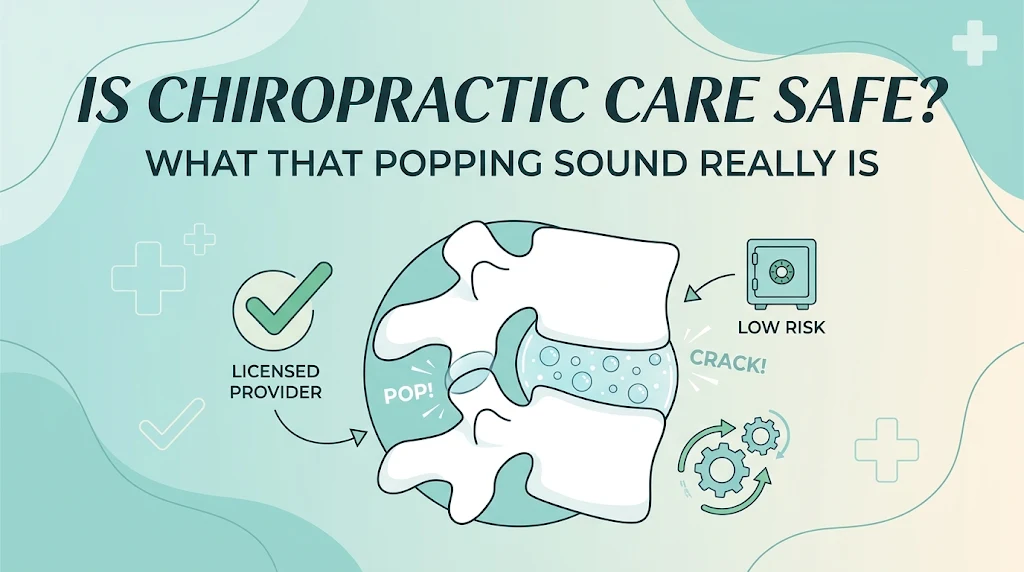
If you’ve never been to a chiropractor, two questions probably come to mind: Is it safe? and What’s that popping sound? Both are fair, and both are among the most common questions we hear.
Here’s a clear, honest look at both, so you know what to expect before your first visit.
Is Chiropractic Care Safe?
For most people, chiropractic care is considered a safe, low-risk, non-surgical option for musculoskeletal pain when it’s provided by a licensed chiropractor after a proper evaluation.
Safety depends on a few key things:
- A thorough exam first. Your chiropractor should review your health history, ask about your symptoms, and examine you before any treatment begins.
- The right technique for you. Not every technique suits every person. Care should be adjusted to your age, condition, and comfort level.
- A licensed, trained provider. Chiropractors are trained to recognize when care is appropriate and when a referral to another provider is the better choice.
Like any form of healthcare, chiropractic care isn’t completely without risk. Mild, short-term side effects are the most common, and serious complications are considered rare. That’s one reason an evaluation always comes first, and why you should tell your chiropractor about your full health history.
What Is That Popping Sound?
The “pop” or “crack” you sometimes hear during an adjustment surprises many first-time patients. It can sound like bones are grinding or breaking, but that’s not what’s happening.
Your spinal joints (and other joints, like your knuckles) are surrounded by a thin capsule containing synovial fluid, which lubricates the joint. This fluid contains dissolved gases. When a joint is moved or stretched quickly, pressure inside the joint changes, and a small gas bubble can form or shift. That rapid change is generally believed to be what creates the popping sound. It’s the same type of sound you hear when you crack your knuckles.
In other words, the pop is most likely gas and fluid inside the joint, not bone rubbing on bone.
Does Every Adjustment Make a Sound?
No. Some adjustments are completely silent and are just as valid. The sound doesn’t tell you how well the adjustment worked, and a louder pop doesn’t mean better results. Techniques like Cox Flexion-Distraction use slow, gentle movements and usually don’t produce any popping at all.
Does Cracking Your Joints Cause Arthritis?
This is a common worry. Research to date has not found that habitual joint cracking leads to arthritis. If a joint is painful, swollen, or pops with discomfort, that’s worth having checked, but a painless pop on its own isn’t usually a concern.
Common Side Effects After an Adjustment
Many patients feel better right away, but it’s normal for some to notice mild effects afterward, such as:
- Mild soreness or stiffness, similar to how you might feel after a new workout
- Slight fatigue
- A mild headache
These effects are usually mild and tend to fade within a day or two. Drinking water, staying gently active, and letting your chiropractor know how you felt can help guide your next visit.
Who May Need a Modified Approach?
Chiropractic care can often be adapted for different people and life stages, including children, adults, and pregnant patients. Some situations call for extra care or a different approach. Tell your chiropractor if you:
- Have osteoporosis or a history of fractures
- Have had spinal surgery
- Take blood thinners or have a bleeding disorder
- Have numbness, tingling, or weakness in your arms or legs
- Have had a recent injury or accident
- Are pregnant (see our guide on chiropractic care during pregnancy)
- Are bringing a child in for care (learn signs your child may benefit)
Sharing this information helps your chiropractor choose the safest, most appropriate technique for you, whether that’s a standard adjustment, a gentler option like flexion-distraction, or a referral to another provider.
Gentler Options If You’re Nervous
Not everyone is comfortable with a quick adjustment, and that’s okay. Many chiropractors offer lower-force options, including:
- Flexion-distraction: slow, rhythmic stretching on a specialized table
- Soft tissue therapies such as the Graston Technique
- Cupping therapy to relax tight muscles
- Therapeutic exercises to build strength and support
If you’re anxious about your first visit, say so. A good chiropractor will explain each step and work at a pace you’re comfortable with.
Red Flags: When to Get Medical Care Right Away
Chiropractic care is for musculoskeletal problems, and some symptoms need urgent medical attention instead. Seek emergency care if you experience:
- Sudden, severe headache or neck pain unlike anything you’ve felt before
- Difficulty speaking, facial drooping, vision changes, or dizziness
- Loss of bladder or bowel control
- Numbness in the groin or inner thighs
- Sudden, severe weakness in an arm or leg
- Severe back pain after a serious fall or accident
How Often Should You Go?
The right schedule depends on your condition and goals. Some people visit for short-term relief, while others prefer regular maintenance care. Our post on how often you should get a chiropractic adjustment can help you understand what to expect.
Frequently Asked Questions
Is chiropractic care safe?
For most people, chiropractic care provided by a licensed chiropractor after a proper exam is considered safe. Mild, short-term soreness is the most common side effect, and serious complications are rare.
What is the popping sound during an adjustment?
It’s generally believed to be a gas bubble forming or shifting in the fluid inside a joint when it’s moved or stretched, similar to cracking your knuckles. It is not bone grinding on bone.
Does an adjustment have to pop to work?
No. Many effective adjustments make no sound, and the loudness of a pop doesn’t measure how well the treatment worked.
Can cracking your back cause arthritis?
Research hasn’t shown that joint cracking causes arthritis. If a joint is painful or swollen, have it evaluated.
Can a chiropractor hurt you?
Mild soreness can happen, and rare complications have been reported. Choosing a licensed chiropractor, sharing your full health history, and speaking up during treatment all help keep care safe and comfortable.
Does chiropractic care hurt?
Most people find adjustments comfortable. You may feel pressure or a stretch, and some people feel mild soreness afterward.
Is chiropractic care safe for children and during pregnancy?
Chiropractic care can often be modified for children and pregnant patients, using gentler techniques. Your chiropractor will evaluate you first and adjust care accordingly.
What should I tell my chiropractor before my first visit?
Share your health history, current medications, past injuries or surgeries, and any symptoms like numbness, tingling, or dizziness.
Safe, Comfortable Care at Well Adjusted Alpharetta
If you’ve been curious about chiropractic care but unsure where to start, we’re happy to answer your questions. At Well Adjusted Alpharetta, we begin with a thorough evaluation, explain your options in plain language, and tailor care to your comfort level. We proudly serve patients in Alpharetta, Roswell, and the surrounding area.
Learn more about our chiropractic adjustments or call us today to schedule your visit.
This article is for general educational purposes and is not a substitute for professional medical advice, diagnosis, or treatment. Individual results vary.