
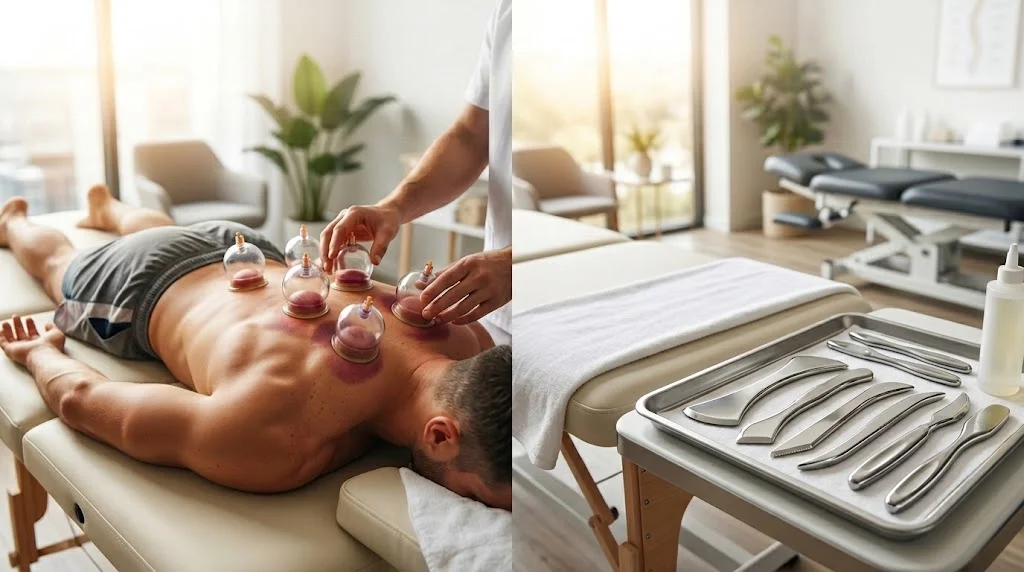
If you’re dealing with muscle tightness, restricted movement, or recovering from an injury, you’ve likely come across two popular soft tissue treatments: cupping therapy and the Graston Technique. Both are widely used to support recovery, reduce tension, and improve mobility — but they work in very different ways, and understanding that difference can help you and your provider choose the right approach for your specific needs.
The Core Difference: Decompression vs. Controlled Pressure
The simplest way to understand these two therapies is by how they interact with your soft tissue.
Cupping therapy works through decompression. Specialized cups are placed on the skin to create gentle suction, lifting the skin and underlying tissue upward. Most manual therapies compress tissue downward — cupping does the opposite, pulling it up instead. This lifting effect helps release tension, improve circulation, and encourage healthy blood flow to the treated area.
Graston Technique works through targeted, controlled pressure. Using specialized stainless-steel instruments, a provider applies pressure to specific areas of restriction, gliding or scraping across the tissue to detect and treat scar tissue, adhesions, and soft-tissue restrictions. Rather than lifting tissue, Graston applies direct mechanical stimulation to encourage the body’s natural healing and remodeling response in the treated area.
What Each Therapy Is Best Suited For
Neither technique is universally “better” — they’re suited to different situations, and the right choice often depends on what your body actually needs.
Cupping tends to be a strong fit for:
- Chronic muscle tightness and tension
- General postural tension (think: tight shoulders and upper back from long hours at a desk)
- Supporting circulation and recovery after intense physical activity
- Patients who prefer a treatment that feels more relaxing and less targeted
Graston Technique tends to be a strong fit for:
- Scar tissue and adhesions from a past injury or surgery
- Specific, localized areas of restriction (a stubborn IT band, tight calf, or restricted shoulder)
- Chronic overuse conditions like tendonitis or shin splints
- Patients who want a more targeted, hands-on approach to a specific problem area
Does the Research Show One Works Better?
Both therapies have real clinical research behind them, and in some head-to-head comparisons, cupping has actually shown a slight edge. A randomized clinical trial studying patients with medial tibial stress syndrome — a common overuse injury in runners, sometimes called shin splints — found that while both cupping and Graston Technique improved pain and function after three weeks of treatment, cupping therapy showed somewhat better results in that specific condition.
That doesn’t mean cupping is the better choice for everyone. Results can vary significantly depending on the condition being treated, the individual patient, and how the therapy is applied. This is exactly why working with an experienced provider matters — the right therapy often depends on your specific situation, not a one-size-fits-all answer.
Can You Use Both?
Yes — and many patients do. Cupping and Graston Technique aren’t competing treatments; they’re often used together as part of a broader care plan. A common approach is to use Graston to address localized restrictions and scar tissue, and cupping to support overall circulation, tension relief, and recovery. Both therapies are also frequently paired with chiropractic adjustments, since properly functioning soft tissue makes it easier for the spine and joints to move the way they’re supposed to.
Which One Is Right for You?
If you’re not sure which therapy fits your situation, that’s completely normal — and it’s exactly the kind of question your provider should help answer. During an evaluation, a chiropractor can assess your specific area of concern, your goals, and your activity level to recommend the therapy — or combination of therapies — most likely to help.
Curious whether cupping therapy or Graston Technique is the right fit for you? Learn more about our Cupping Therapy and Graston Technique services, or call us today to schedule a consultation.